
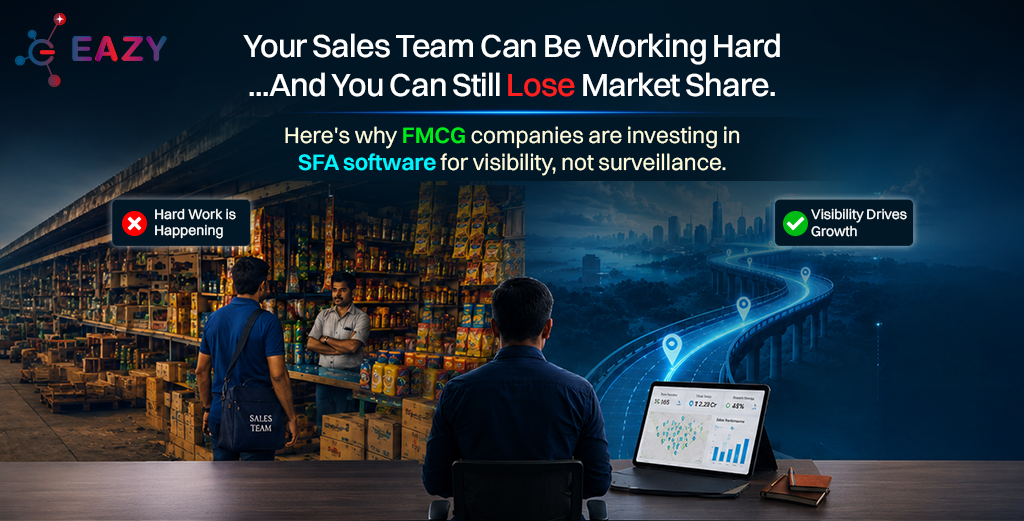
SFA Software for FMCG: The Complete India Guide (2026)
Reading Time: 6 Min Read | Published: 21 July 2026
Key Highlights (What you’ll learn)
- What SFA software actually does in an FMCG context
- Why Indian field sales teams need SFA built differently from global tools
- Key features to evaluate before you buy
- How SFA and DMS work together for end-to-end visibility
- When your business is ready for SFA and what happens when you delay
Somewhere between your NSM’s quarterly plan and what actually happened at the retail counter last Tuesday, there is a gap.
A field rep visited 38 outlets. You know this because the app showed 38 check-ins but which outlets placed orders? Which ones had a competitor’s product facing your shelf space? Which ones received the wrong trade scheme? Which distributor serving that beat is sitting on 30 days of dead stock?
Most FMCG brands in India cannot answer these questions without making three phone calls, pulling two spreadsheets, and waiting until Friday. That is not a people problem, and neither a discipline problem. It is an architecture problem and Sales Force Automation software is what fixes it.
What Is SFA Software?
Definition: Sales Force Automation (SFA) software is a platform that digitises and structures the work of a field sales team from planning visits and capturing orders to applying trade schemes, tracking outlet coverage, and feeding real-time activity data back to managers and leadership.
So basically, SFA software automates the repetitive, high-frequency work of field representatives, so that instead of logging orders on WhatsApp and calling in beat updates at 6 PM, every action is captured in real time, structured, and visible to the entire organisation.
In FMCG specifically, the unit of work is the outlet visit, not the sales deal. A field rep may visit 30 to 50 outlets in a single day across a defined beat. SFA structures every one of those visits: who was visited, what was ordered, what scheme was applied, what the shelf looked like, and what happened with the competitor next to your product.
Without SFA, this information either doesn’t reach the business at all, or arrives filtered, delayed, and shaped by whoever is reporting it.
Why Indian FMCG Needs SFA Built Differently
Most SFA tools in the global market were designed for B2B sales cycles: long deals, CRM pipelines, account management. That architecture does not fit how Indian FMCG field sales actually works.
- Connectivity gaps in Tier 2 and Tier 3 markets. A field rep covering Siliguri, Morbi, or Bathinda cannot depend on a stable internet connection to log an order. SFA software that requires connectivity to function will fail exactly where your growth is happening. According to BCG, nearly 600 Tier 2 and Tier 3 cities account for 36% of India’s FMCG consumption and this is precisely where offline-first functionality is non-negotiable because India has over 650,000 villages, making offline capability essential for field sales teams.
- Beat-based territory structures. Indian FMCG runs on beats, pre-defined routes that a field representative covers on a fixed schedule. Beat planning, beat adherence, and beat-level performance analytics are core requirements, not optional modules. Global tools often treat this as a customisation request.
- Complex trade scheme management. Indian FMCG runs on schemes: promotional discounts, free goods, seasonal offers, that change frequently and must be applied accurately at the point of order. A field rep applying the wrong scheme at 40 outlets in a day creates a claims problem that takes weeks to unwind. SFA needs to make scheme visibility instant and error-proof.
- Multi-tier distribution structures. C&F(Clearing & forwarding) agents, super stockists, distributors, wholesalers and retailers exist in layered structures that vary by region, zone, state, category, and channel. SFA must accommodate these structures natively, not through workarounds or customisations.
- Multilingual field teams. A field team spanning UP, Tamil Nadu, and Gujarat cannot operate on a single-language interface. The app that a field rep uses daily must work in the language they are most comfortable in, along with providing support in the same.
An SFA built for Indian FMCG from the ground up handles all of these realities as standard. One that was adapted from a global tool will create friction at every one of these points, which is usually why field adoption fails before the software even has a chance to prove its value.
What SFA Software Actually Does: Core Capabilities
- Beat Planning and Outlet Coverage
SFA assigns structured daily beat routes to every sales field representative, this includes outlet list, visit sequence, coverage targets, and priority tiers. All of these, along with GPS-verified check-ins confirm that visits happened at the right outlet, at the right time, and not from a parking lot three streets away.
This ensures that managers see coverage gaps in real time, not when the Friday report arrives and the week is already over.
- Digital Order Booking
Field reps capture orders at the outlet floor with live scheme visibility, current stock levels, and SKU recommendations available on the app. Orders are structured, accurate, and submitted instantly, no WhatsApp messages, no manual re-entry, no errors from verbal communication.
For Tier 2 and Tier 3 markets where connectivity is unreliable, orders are captured offline and synced automatically when connectivity is restored. Not a single order is lost because of a network issue.
- Trade Scheme Management
Every active trade scheme is visible to the field rep during order booking, what applies to this outlet, this SKU, and this order value. Scheme compliance is tracked at the outlet level. Leadership can see which outlets received the correct scheme, where it was misapplied, and which promotions are driving incremental sales versus simply moving existing demand forward.
This is the visibility that prevents crores of promotional spend from leaking through a distribution chain with no system to verify what reached the retailer.
- Real-Time Field Tracking and Reporting
Sales managers get live visibility into field rep activity: who is where, which outlets have been visited, which ones are pending, and which beats are running behind schedule. Instead of waiting for end-of-day phone calls, managers can intervene and redirect in real time.
Underperforming territories surface within days, not at the quarterly review when corrective action is expensive and slow.
- Secondary Sales Visibility
This is where SFA and DMS converge and where Indian FMCG brands consistently have their largest blind spot. SFA captures what is happening at the outlet: what was ordered, what was on the shelf, what the retailer said. DMS captures what is happening at the distributor: stock levels, billing, secondary sales flowing to retailers. When these two systems are connected and connected to the ERP, a brand can trace a clean line from a field rep’s order, through distributor stock, to the retailer’s shelf, to the cash collected.
This is end-to-end visibility and it is the primary reason FMCG brands that implement SFA and DMS together consistently outperform those that run either system in isolation.
Read more on how DMS provides secondary sales visibility →
- Performance Dashboards and Analytics
NSMs and ZSMs get live dashboards showing field rep performance, outlet coverage rates, order values by beat and territory, scheme compliance, and productivity metrics without asking anyone to compile a report. Hence, leadership makes decisions on data that is hours old, not weeks old.
What to Look for Before You Buy SFA Software in India
Most SFA software buying guides list features: GPS tracking, order management, dashboards. Every platform has these. The real evaluation is different.
- Is it offline-first or offline-capable?
These are not the same thing. Offline-first means the app was built to work without connectivity as the default. Offline-capable means it was retrofitted with a limited offline mode. In markets where your reps spend hours without a signal, this distinction determines whether your investment works or sits unused. - Was it built for Indian FMCG or adapted for it?
Ask the vendor directly: was beat planning, van sales, trade scheme management, and multi-tier distribution built into the original product or added later as customisation? The difference shows up in how naturally field teams adopt it. - How fast can you go live?
Implementations that take months can delay ROI and eventually reduce adoption. The best SFA platforms for FMCG in India go live in days, not taking entire quarters. Ask for the average go-live time for companies your size. - Does it connect natively with your DMS?
If SFA and DMS are separate products from separate vendors with an API bridge between them, data gaps, sync delays, and a support conversation every time something breaks is bound to happen down the lane. Native integration where SFA and DMS are built as one connected system is significantly more reliable and gives leadership a single source of truth. - What does field team adoption actually look like?
The most sophisticated SFA in the market is worthless if your field reps avoid it after the first week. Ask for data on adoption rates, not just feature lists. Talk to a reference customer about what the first 30 days looked like on the ground. - What are the total costs over 12 months?
Many vendors quote attractive per-user pricing and then add implementation fees, training costs, server charges, and customisation costs. Ask for a total 12-month cost inclusive of everything before you compare options.
SFA and DMS Together: Why Brands at Scale Need Both
Here is what each covers:
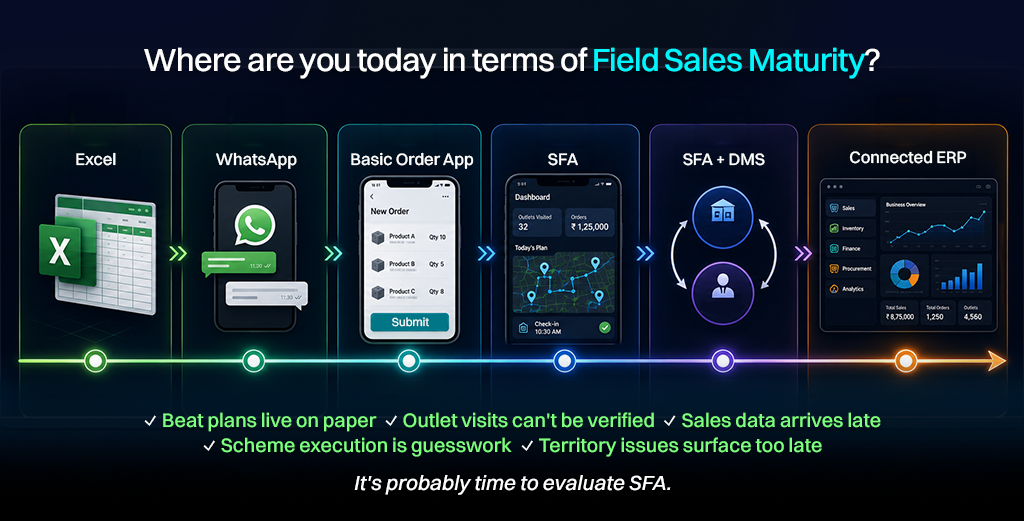
SFA tells you what is happening at the outlet: whether the beat was covered, what was ordered, how the scheme was applied, what the shelf looked like. DMS tells you what is happening at the distributor: stock levels, secondary sales, claims, collections, billing. ERP tells you what is happening at the manufacturing and finance level: production, procurement, P&L.
When all three are connected, an NSM sitting in Gurugram can see what a field rep just did at a kirana store in Coimbatore, what stock the local distributor has available to fulfil that order, and whether the trade scheme that rep applied is within the approved budget, all in real time, without a single phone call.
Most FMCG brands scaling past ₹100 crore in revenue find they need both SFA and DMS working as a connected system. Implementing one without the other leaves a visibility gap that grows more expensive as the business scales.
When Does an FMCG Brand Need SFA?
A field sales team operating on WhatsApp, verbal updates, and end-of-day Excel reports is already incurring a cost, in missed orders, ghost visits, wrong scheme applications, and delayed decisions. The question is not whether that cost exists, the question is how long to carry it.
Most FMCG brands should evaluate SFA when:
- Field team size exceeds 10 representatives
- Operations span more than two states
- Beat adherence and outlet coverage cannot be verified without calling the rep
- Trade scheme errors are creating claims backlogs
- Leadership is making territory and range decisions based on data that is more than 72 hours old
- A new product launch requires coordinated execution across hundreds of outlets simultaneously
- The business is entering Tier 2 or Tier 3 markets where WhatsApp-based coordination breaks down
If four or more of these apply to your business today, the cost of delay is already higher than the cost of implementation.
Final Takeaway
The real question isn’t whether your field team is working hard, it is whether leadership can see what they’re working on, while there’s still time to act. That’s the difference between tracking activity and managing execution and that’s exactly what modern SFA software is built to solve.
If you’re unsure whether your current setup has already outgrown WhatsApp, Excel, or manual reporting, start with a conversation, not a product demo. We’ll help you assess your current field sales process and tell you honestly whether SFA makes sense for your business today.
→ Book Free Consultation with us.
Found this useful? Forward it to your NSM or VP Sales, the questions in the “Signs Your Setup Has Outgrown WhatsApp” section are worth 10 minutes of their time.
Or start a conversation: What is the one thing your field team does today that you cannot verify without making a phone call? Tell us on LinkedIn →
Trusted by 650+ businesses, supporting over 3 million users across manufacturing, FMCG, and distribution in 20+ countries.
At Eazy, we help businesses implement connected ERP, DMS, SFA, and retail ecosystems designed for long-term adoption, visibility, and operational scalability.
FAQs
1. What is SFA software in FMCG?
Sales Force Automation software in FMCG is a platform that digitises field sales operations, beat planning, outlet visits, order booking, trade scheme management, and real-time reporting. It replaces WhatsApp, paper forms, and end-of-day phone calls with structured, real-time data that flows directly to managers and leadership.
2. What is the difference between SFA and CRM?
CRM manages customer relationships, lead pipelines, and sales deals, typically for B2B or enterprise sales cycles. SFA manages high-frequency, territory-based field execution, outlet visits, order capture, beat coverage, and scheme management. FMCG brands need SFA for field operations. CRM is typically used by inside sales or key account teams.
Learn how EAZY CRM works alongside SFA →
3. What is beat planning in field sales?
Beat planning is the process of assigning a pre-defined route of retail outlets to a field representative, with a fixed visit schedule and coverage targets. SFA platforms structure and track beat execution, GPS-verifying that visits happened at the correct outlet and time, and flagging missed or skipped outlets in real time.
4. Does SFA software work without the internet in rural areas?
It depends on the platform. The best SFA software for FMCG in India is built offline-first, meaning all features work without connectivity and data syncs automatically when a connection is restored. This is non-negotiable for field teams operating in Tier 2 and Tier 3 markets. Confirm this with your vendor before signing any contract.
5. What is the difference between SFA and DMS?
SFA manages what happens at the field and outlet level, rep visits, orders, scheme application, and coverage. DMS manages what happens at the distributor level, secondary sales, stock, billing, claims, and collections. The two are complementary. SFA captures demand at the outlet; DMS fulfills and reconciles it at the distributor. Connected together, they provide end-to-end channel visibility.
6. How long does SFA implementation take?
With the right platform, a field sales team can be live and take orders within days. Implementation timelines vary based on team size, beat structure complexity, and data migration requirements, not software complexity. Ask your vendor for the average go-live time for an organisation similar to yours.
7. Can WhatsApp replace SFA for small FMCG teams?
For very small teams operating in a single city or region, WhatsApp-based coordination may be sufficient in the short term. As the field team grows, territories expand, and scheme complexity increases, WhatsApp creates visibility gaps that compound quickly. The cost of untracked ghost visits, wrong scheme applications, and delayed reporting typically exceeds the cost of SFA well before most brands realise it.
8. What Indian-specific features should FMCG brands look for in SFA?
Beat planning, van sales support, offline-first functionality, multi-lingual interface, trade scheme management built natively, compatibility with Indian DMS and ERP structures, and the ability to handle multi-tier distribution including C&F agents, super stockists, and distributors. Global SFA tools adapted for India often require expensive customisation to support these requirements.
9. Do I need SFA and DMS together?
Yes, for most FMCG brands operating at scale. SFA without DMS gives you field visibility but not distributor visibility. DMS without SFA gives you distributor data but not outlet-level execution data. Together, they close the channel visibility gap from factory to shelf.
10. How is EAZY SFA different from other SFA tools in India?
EAZY SFA is built as a connected system with EAZY DMS, not two separate products integrated via API. This means field rep activity, distributor stock, and secondary sales share a single data layer. It is built specifically for Indian FMCG distribution structures including beat planning, scheme management, and offline operation in low-connectivity markets. Most brands go live within days, not months.
See EAZY SFA in action →